
In the first part of our series of articles examining the development status and prestige of Baranya County (which can be read here: Baranya’s EU Development in Numbers I | Invest In Baranya), we examined whether the county is underfunded in terms of EU resources compared to other counties, and if so, how is this evident? The data presented in the article led to the conclusion that, in terms of development funds per capita, Baranya is by no means underfunded—in fact, in certain indicators (EU funding per capita for the 2014–2020 cycle), it is notably favorable, ranking fourth.
In light of all this, it is interesting to note that the situation within the county presents a much more nuanced picture.
In this article, we used data from the 2022 census and, in the interest of transparency, relied on the official data published on the website www.palyazat.gov.hu.
Basics
Baranya is the county with the highest proportion of small villages in the country, comprising 301 settlements. It has a population of 354,022, with 59.9% living in towns and 40.1% in villages.
The population of the county by district is as follows:
| District | Population (persons) |
| Bóly | 11,121 |
| Hegyháti | 11,163 |
| Komló | 31,975 |
| Mohács | 32,705 |
| Pécs | 172,908 |
| Pécsvárad | 11,111 |
| Sellye | 12,622 |
| Siklós | 33,620 |
| Szentlőrinc | 13,901 |
| Szigetvár | 22,896 |
It is clear that Baranya County is distinctly county-seat-centric, as 39.36% of the county’s population lives in Pécs, while nearly half—48.84%—lives in the Pécs district.
From a development policy perspective, this poses an enormous challenge, because while nearly half of the county’s population lives in the county seat or its immediate vicinity, the other half lives farther away in the rest of the county, and with settlement development indicators that are below average.
While the Pécs metropolitan area is significant—it could account for nearly half of all non-agricultural EU funding allocated to the county—catch-up development must be prioritized in the county’s rural areas. This is always a huge challenge in regional development.
We also wanted to find out whether the preferential treatment in development policy—commonly referred to in everyday language as the “county-wide east-west divide”—in favor of the eastern part of the county actually exists, or has this always been nothing more than an unfounded theory?
City and Village
The total amount of EU Operational Program (OP) funding (excluding the Rural Development Program) that was allocated to the county, spent here, and disbursed during the 2014–2020 period was approximately 312.45 billion HUF.The Pécs-Baranya dilemma raised above is somewhat clarified by the fact that, if we examine how this amount is distributed among cities and villages, as well as between the Pécs district and the rest of the county.
The population of the Pécs district thus accounts for 48.84% of the county’s total population, and at the same time, 53.33% of the allocated EU funds went to this district. In other words, development policy (in terms of location) tends to favor the county seat with regard to population-based funding.
When it comes to urban and rural areas, the picture is more nuanced. In Baranya County, 59.9% of the population lives in cities and 40.10% in villages; however, cities received 71.53% of total funding, while villages received 28.47%.
However, it must be taken into account that the main functions (the economy, public administration, services, healthcare, and secondary and higher education) are primarily available in cities; thus, although the “overfunding” of cities may seem significant, in reality, it is not excessive.
| Total EU funding | Proportion of funding | Population | Percentage of population | |
| Cities: | 223,510 658,596 | 71.53% | 212,043 | 59.90% |
| Villages | 88,941 | 28.47% | 141,979 | 40.10% |
Is there an “east-west divide” within the county?
Before we continue, we need to clarify what constitutes the eastern and western parts of the county:
- purely western districts: the districts of Sellye, Szigetvár, and Szentlőrinc.
- Districts in the eastern region: Bóly, Mohács, and Pécsvárad
In addition to the above, it is essential to treat the northern districts (Komló, Hegykő), the southern district (Siklós), and, of course, the county seat separately. This is important because it makes the final conclusions clearer and more systematic.
The table below summarizes the amount of funding each district in Baranya County received and the per capita amount for each district.
| District | Population | Total EU funding | Total EU funding per capita in the district |
| Bóly | 11,121 | 14,492,354,886 | 1,303,152 |
| Hegyháti | 11,163 | 7,858 128,836 | 703,944 |
| Komlói | 31,975 | 21,673 586,206 | 677,829 |
| Mohács | 32,705 | 41,856 186,004 | 1,279,810 |
| Pécs | 172,908 | 166,643 889,177 | 963,772 |
| Pécsvárad | 11,111 | 4,301,834,502 | 387,169 |
| Sellye | 12,622 | 11,107,320,485 | 879,997 |
| Siklós | 33,620 | 21,288 351,813 | 633,205 |
| Szentlőrinc | 13,901 | 4,871 701,048 | 350,457 |
| Szigetvár | 22,896 | 18,366 103,925 | 802,153 |
| TOTAL: | 312,459 456,882 | ||
So, if we look at the nominal figures, the Pécs district received by far the most funding, followed by the Mohács, Komló, Siklós, Szigetvár, Bóly, Sellye, Hegykő, Szentlőrinc, and finally the Pécsvárad district.
However, it is more important here as well to use per capita EU funding as a basis, since regional development is fundamentally people-centered, and per capita indicators better reflect the actual extent of a given county’s development resources.
Per capita, EU funding in the districts breaks down as follows:
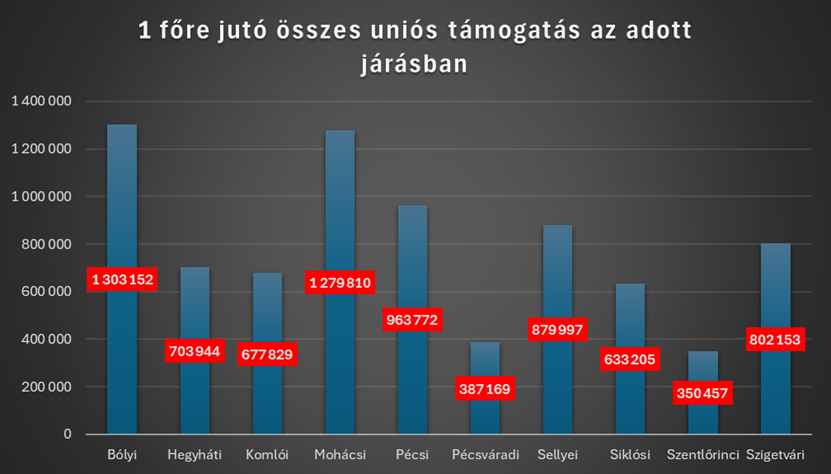
Here it is even clearer that, in relative terms, the districts of Mohács and Bóly received by far the most EU funding, followed at a considerable distance by, in order, the districts of Pécs, Sellye, Szigetvár, Hegykő, Komló, Siklós, Pécsvárad, and finally Szentlőrinc districts.
The picture becomes even clearer when we examine the so-called sectoral distribution of aid, specifically in economic development and human development.
The distribution of economic development grants among the individual counties is as follows:
| District | Total amount of economic development grants in the district | EU economic development aid per capita in the district |
| Bóly | 2,875,865,019 | 258,598 |
| Hegyháti | 2,821,370,194 | 252,743 |
| Komlói | 8,254,320,792 | 258,149 |
| Mohács | 3,373,840,946 | 103,160 |
| Pécs | 62,675,442,076 | 362,479 |
| Pécsvárad | 1,574,685,578 | 141,723 |
| Sellye | 1,744,072,036 | 138,177 |
| Siklós | 6,085,760,222 | 181,016 |
| Szentlőrinci | 1,015,943,372 | 73,084 |
| Szigetvár | 6,885,762,160 | 300,741 |
Here's how it looks on the graph:
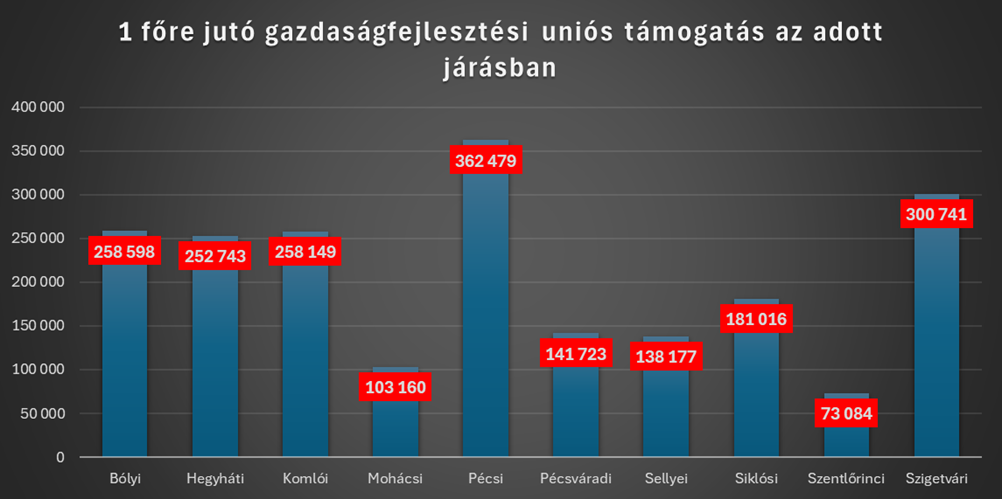
It is clear that support for the Pécs district is exceptionally high in relative terms (which is no surprise, given that it is the county seat), followed at a considerable distance by the districts of Szigetvár, Bóly, Komló, Siklós, Pécsvárad, Sellye, Mohács, and finally Szentlőrinc.
In and of themselves, therefore, the typically eastern districts were not only not over-subsidized in EU grant programs aimed at economic development, but actually lagged behind the western (Szigetvár), northern (Komló), and southern (Siklós) districts.
The reason for this is simple: while the eastern districts no longer receive funding—having already received and utilized economic development grants in previous years—significant resources have been allocated to the eastern, southern, and northern districts for the purpose of catching up, as part of regional equalization efforts.
As for human development grants, we can identify the following, also presented in tables and charts:
| District | Total EU human development funding in the district | EU human development funding per capita in the given district |
| Bóly | 914,358,180 | 82,219 |
| Hegyháti | 2,416,567,561 | 216,480 |
| Komlói | 2,985,318,742 | 93,364 |
| Mohács | 3,743,273,253 | 114,456 |
| Pécs | 35,660,879,936 | 206,242 |
| Pécsvárad | 1,103,905,532 | 99,352 |
| Sellye | 4,174,240,919 | 330,712 |
| Siklós | 4,941,347,821 | 146,976 |
| Szentlőrinci | 1,896,710,051 | 136,444 |
| Szigetvár | 4,816,374,094 | 210,359 |
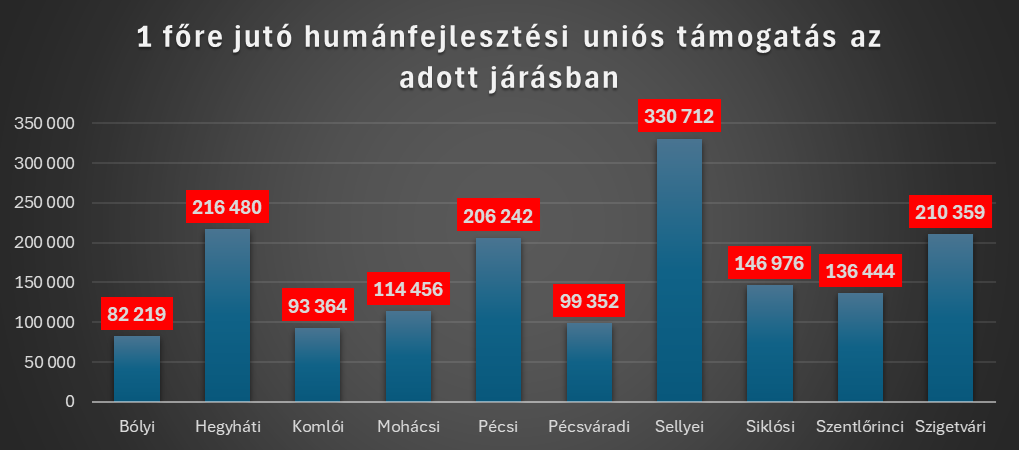
The role of the Pécs district in the total nominal amount of aid is, of course, prominent here as well due to its high proportion of the county’s population (48.84%); however, when we look at the per capita figures, the picture is much more nuanced.
On a per capita basis, the Sellye district received the most EU funding for human development, followed in order by the Hegyhát, Szigetvár, Pécs, Siklós, Szentlőrinc, Mohács, Pécsvárad, Komló, and finally Bóly districts.
Of course, the rationale behind this is purely based on regional development logic: In Baranya County, Sellye and Hegykő are the two most disadvantaged districts; consequently, (due to the need for catch-up development) the majority of sectoral resources must be allocated to these (and, thirdly, to Szigetvár).
We would also like to highlight another important indicator: the allocation of funds under the Regional and Urban Development Operational Program (TOP).
| District | Total amount of community development grants in the district | EU human development funding per capita in the district |
| Bóly | 2,077,446,191 | 186,804 |
| Hegyháti | 2,092,079,480 | 187,412 |
| Komlói | 7,768,773,201 | 242,964 |
| Mohács | 12,803,250,609 | 391,477 |
| Pécs | 42,445,643,315 | 245,481 |
| Pécsvárad | 1,393,668,538 | 125,431 |
| Sellye | 1,955,092,031 | 154,896 |
| Siklós | 7,687,742,864 | 228,666 |
| Szentlőrinci | 1,857,834,225 | 133,648 |
| Szigetvár | 5,897,920,349 | 257,596 |
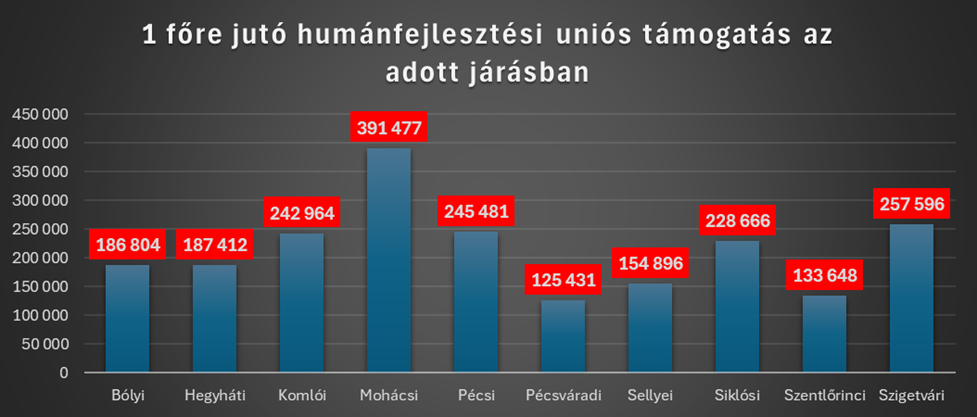
TOP funds were allocated and used for a variety of purposes, but primarily for the development and more efficient operation of municipalities; however, no significant differences are apparent here: in nominal terms, of course, the Pécs district received the most, followed by the Mohács district (which is also the district with the second-largest population), then the Komló district (which is also the third-largest in terms of population), followed by the districts of Siklós, Szigetvár, Hegykő, Bóly, Szentlőrinc, Sellye, and Pécsvárad.
In terms of population density, Mohács does indeed stand out, but the Bóly district, for example, does not at all; and while the Sellye and Hegykő districts are underrepresented, the Szigetvár district is certainly not.
Summary
Although it may sound appealing to highlight the urban-rural divide within the county, the nature of development policy, regional social dynamics, and the structure of the economy mean that there is no discernible shift in emphasis to the detriment of rural areas.
As for the east-west divide within the county, the picture is more nuanced:
- Yes, based on development indicators, the western districts are less developed than the eastern ones. However, a similar level of underdevelopment can also be observed in the southern (Siklós) and northern (Hegykő) districts.
- The catch-up process had already begun during the 2014–2020 cycle, as the data clearly showed.
- If one must define some kind of polar opposition, it is far more accurate to say that one pole is formed by the county seat and the eastern districts, while the other pole is formed by the western, southern, and northern districts.
It is a fact, however, that significant infrastructure developments are essential for the western districts to catch up effectively, which is why the construction of the Pécs–Barcs expressway section is of paramount importance.
It is a timeless truism in development policy and regional development that the world is constantly changing, so there is always work to be done.
It's no different in Baranya.