A special financing opportunity is being developed for micro, small, and medium-sized enterprises investing in Baranya County. Under the Fair Transition Fund’s new SME Loan Program, funding ranging from 5 to 500 million forints can be requested, up to half of which may be a non-repayable grant, with the remainder available as an interest-free investment loan. A separate budget of 11 billion forints is planned for projects implemented in Baranya County.
The draft call for proposals titled “Just Transition Fund (JTF) SME Loan Program,” with the reference number KEHOP Plusz-5.1.0-26, has been released for public consultation. The total budget for the program is 31 billion forints: of this amount, 11 billion forints would be allocated to projects in Baranya County, and an additional 20 billion forints would be allocated to projects in Borsod-Abaúj-Zemplén and Heves counties.
The program serves a dual purpose. On the one hand, it would support a substantial reduction in businesses’ energy consumption and greenhouse gas emissions; on the other hand, it would provide funding for the development of new products, services, and business activities related to the green and circular economy.
It is important to note, however, that this is currently only a draft call for proposals. The terms and conditions may still be subject to change during the public consultation process and upon the publication of the final call for proposals.
An Interest-Free Loan and a Non-Refundable Grant Combined into a Single Program
The loan program offers what is known as “single-step combined financing.” This means that businesses can apply for both an interest-free investment loan and a non-repayable grant through a single application.
Under the draft, funding of at least 5 million and up to 500 million forints may be requested per project. Up to 50 percent of this amount may be a non-repayable grant, the amount of which may not exceed the amount of the interest-free loan portion. However, the highest grant rate is not automatically granted: its actual amount is influenced by the size of the business, the nature of the investment, and the applicable state aid category. The aid component of the preferential loan is also included in the permitted aid intensity.
Businesses must provide at least 10 percent of the project’s eligible costs from their own funds. These funds must be free of any government support, and proof of their use must be provided no later than before the first disbursement.
The interest rate on this loan is zero percent per year, both during the grace period and thereafter. No handling fees, commitment fees, prepayment fees, or contract amendment fees are charged; however, costs such as those for appraisals or notary fees payable to third parties may be borne by the business. For the purchase of tangible assets, a supplier advance of up to 50 percent of the financing amount may also be utilized.
Businesses can choose from two types of development goals
The program’s first priority area encompasses technology transition, emissions reduction, and energy efficiency upgrades.
Eligible for funding may include, among other things:
- replacing existing production technology with new, energy-efficient machinery and equipment;
- modernization of manufacturing processes;
- purchasing energy-efficient equipment and solutions to optimize production;
- utilization of waste heat and residual heat from one’s own or other facilities;
- insulation of building facades, floors, or roofs;
- replacement of windows and doors and installation of window shades;
- modernization of heating, cooling, ventilation, and domestic hot water systems;
- installation of heat pumps, heat recovery systems, and solar collectors;
- energy-efficient, sensor-controlled lighting;
- the use of energy management systems and smart meters.
Energy efficiency investments must achieve primary energy savings of at least 30 percent. In the case of technology replacement, the savings must be demonstrated with respect to the relevant production process, machinery, or logistics unit, while maintaining at least the previous production capacity. For building energy efficiency improvements, this requirement must be met on a per-building basis; for complex investments—involving both buildings and technology—it must be met on a per-site basis.
In the case of technology transitions aimed at reducing emissions, a reduction in greenhouse gas emissions of at least 30 percent must also be demonstrated. In this context, new equipment and technologies related to electrification, green hydrogen, or biogas use may also be eligible for support.
The expected energy savings or emissions reductions must be substantiated with appropriate energy documentation or an audit at the time the application is submitted. After the project is completed, a follow-up measurement will verify whether the business has actually achieved the promised results.
A solar panel can only be part of a complex development
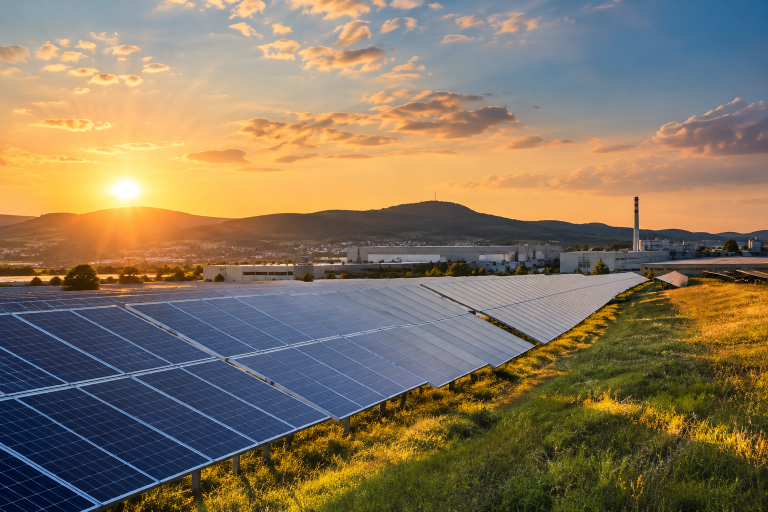
According to the draft call for proposals, solar panel systems and electricity storage systems may be included in the project, but they are not eligible for funding as standalone investments. They may only serve as supplementary components of a comprehensive energy efficiency or technology transition project, and their combined cost may not exceed 20 percent of the total eligible project cost.
The electricity generated must be used to meet the business’s own consumption; the subsidized system may not feed electricity back into the grid. Savings resulting from solar power generation may not be counted toward the mandatory 30 percent primary energy savings target.
New equipment, heating systems, and energy-generation technologies that directly use fossil fuels—such as natural gas, coal, or mixed fuels—are not eligible for funding under the program.
New green and circular economy business ventures can also be launched
The second priority area supports the economic diversification of businesses. Under this initiative, funding is available for investments that create new or significantly expanded green economy, circular production, or service activities, while helping to preserve existing jobs.
Eligible clean technologies may include, among others, solar and wind energy technologies, batteries and energy storage systems, heat pumps, geothermal and hydrogen technologies, sustainable biogas and biomethane solutions, electric charging and grid technologies, as well as other energy efficiency and decarbonization solutions.
The scope of development related to the circular economy may be even broader than this. Investments that meet the following criteria are eligible for support:
- reduce material consumption or the amount of manufacturing scrap;
- increase the products’ lifespan, repairability, or recyclability;
- create capacity for the refurbishment, repair, or remanufacturing of used products;
- develop a business model based on asset sharing, rental, or “product-as-a-service”;
- establish a waste collection, take-back, or reverse logistics system;
- they facilitate the processing and reuse of waste, byproducts, and secondary raw materials;
- They are creating a digital marketplace or other technological solution for the distribution of secondary raw materials and reusable products.
In this target area, in addition to the purchase of new machinery and equipment, the development may also involve the construction, expansion, renovation, or modernization of real estate. As supplementary activities, market surveys, market research, marketing activities, and participation in domestic and international trade fairs may also be eligible for funding, subject to specific cost limits.
It is not the company’s registered office that matters, but the location of the investment
One important territorial rule of the program is that it is not necessary to have a registered office in Baranya County. A project by a company registered in another county or even abroad may be eligible for funding if the investment is carried out in Baranya County.
However, at the time the loan application is submitted, the project site must already be listed in the commercial register or another appropriate registry as the company’s registered office, business location, or branch office. The beneficiary must conduct business activities at this location throughout the entire term of the loan.
Micro, small, and medium-sized enterprises that have completed at least one full, closed fiscal year are eligible to apply for the program. Sole proprietorships, business entities, cooperatives, and certain nonprofit business entities are also eligible. However, start-ups and consortia are not eligible to participate in the program.
The total amount of funding that may be requested may not exceed fifteen times the operating profit for the full, closed fiscal year preceding the review of the application.
Strict performance requirements are attached to the grant
Retention of the non-repayable portion of the grant is contingent upon the achievement of the agreed-upon results.
For projects aimed at improving energy efficiency or reducing emissions, a 30 percent savings or emissions reduction is a fundamental eligibility requirement. If the company cannot adequately demonstrate this upon project completion, the draft regulation states that the transaction may be deemed irregular, and the full amount of funding disbursed may be reclaimed.
For projects aimed at diversification, the retention of existing jobs is the primary performance requirement. If the business fails to meet the employment commitment specified in the loan agreement, the non-repayable grant portion may be converted into an interest-free loan.
The application period may begin in January 2027
According to the planned schedule, businesses may submit their applications to designated intermediaries in the MFB Pont Plusz network between January 1 and October 31, 2027, or until the available funding is exhausted. A business may have no more than one approved application per target area.
Projects must be completed both physically and financially within 24 months of the contract being signed. The term of the loan is aligned with the depreciation of the acquired assets; for developments that include building energy efficiency improvements or real estate investments, the term may not exceed 120 months.
As a general rule, construction may only begin after the application has been submitted. The start of work may be defined not only as the commencement of construction activities but also as the first legally binding commitment to order equipment. For this reason, businesses applying for the grant must pay particular attention to the scheduling of preparations and procurements.
It’s a good idea to start preparing for projects now
The 11 billion forint budget allocated specifically for Baranya County could be one of the most significant development opportunities in recent times, particularly for the county’s businesses and investment sites.
The program is not simply a grant for equipment purchases: businesses must demonstrate measurable energy-saving or emissions-reduction results, as well as genuine diversification into the green economy. For this reason, even before the final call for proposals is published, it is advisable to review the technical details of the planned investment, the legal status of the facility, the need for energy-related documentation, the availability of own funds, and the employment commitments that can be undertaken.
Comments on the draft call for proposals may be submitted through the Partnership Forum section of the Application Portal until October 12, 2026. Businesses intending to apply must, in all cases, base their applications on the terms and conditions in effect at the time the final call for proposals is published.
Sources: Grant Portal – public consultation; KEHOP Plus 5.1.0-26 draft call for proposals; Pécs-Baranya Chamber of Commerce and Industry.